
Perseid Meteor Shower
What are the Perseids?
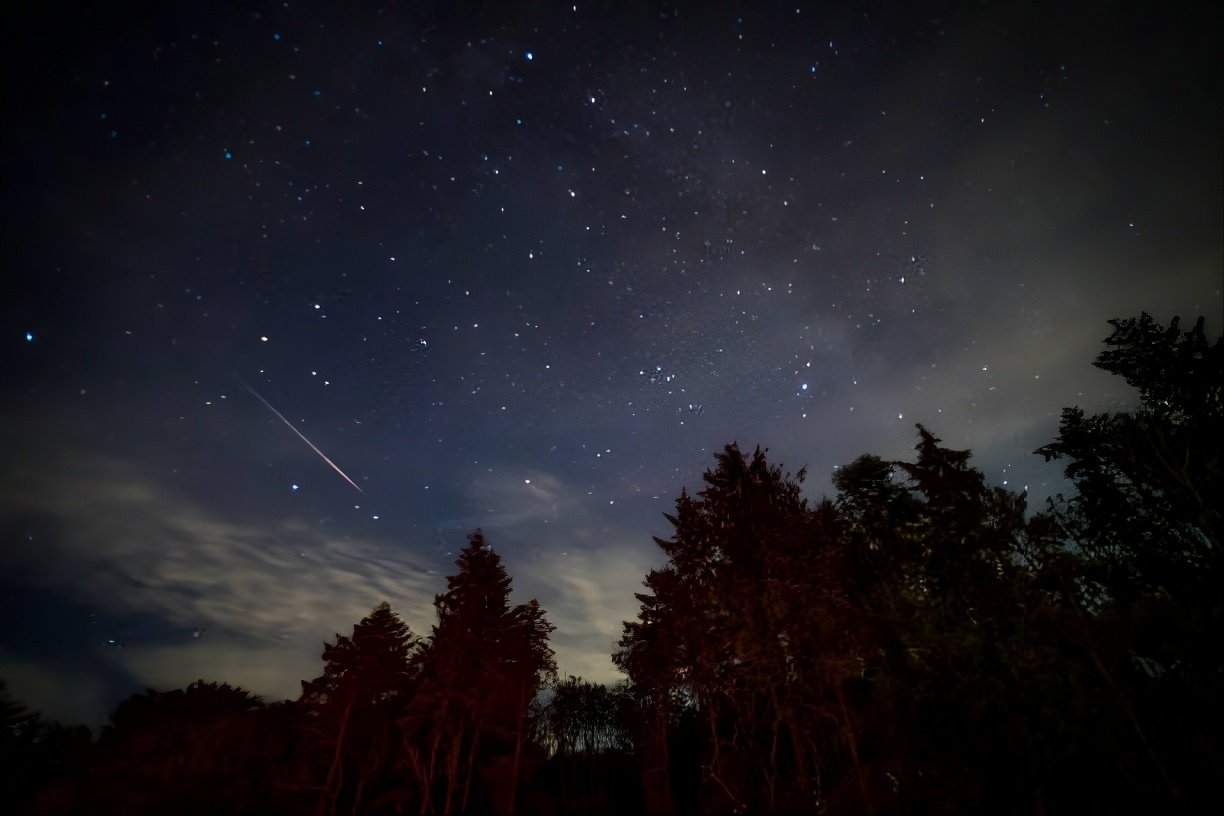
Every summer, Earth passes through a stream of dust and grit left behind by Comet Swift–Tuttle. As these tiny particles, most no bigger than a grain of sand, hit our atmosphere at around 37 miles per second, they burn up and leave bright streaks across the sky. Those streaks are the Perseids.
Comet Swift–Tuttle orbits the Sun once every 133 years. It last passed close to us in 1992 and won’t return until 2126, but the trail of debris it has shed over thousands of years is still there, and Earth ploughs through it every August.
The shower gets its name from the constellation Perseus, the point in the sky the meteors appear to come from. In parts of Europe it’s also known as the Tears of St Lawrence, after the saint whose feast day falls on 10 August, close to the peak.
When to see the Perseids
The Perseids are active from mid-July to late August, but the best nights are around the peak on 12–13 August. Under a properly dark sky, rates can reach around 100 meteors an hour. Most people will count fewer, but even a few nights either side of the peak can be rewarding.
The best time to watch is after midnight. Perseus rises in the north-east in the evening and climbs higher through the night, and the higher it gets, the more meteors you’ll see. The hours before dawn are usually the most productive.
The Moon makes a big difference from year to year. A bright Moon washes out the fainter meteors, so check its phase before you plan your night. In years when the Moon is bright at the peak, the nights a few days earlier can be better.
How to find the Perseid radiant
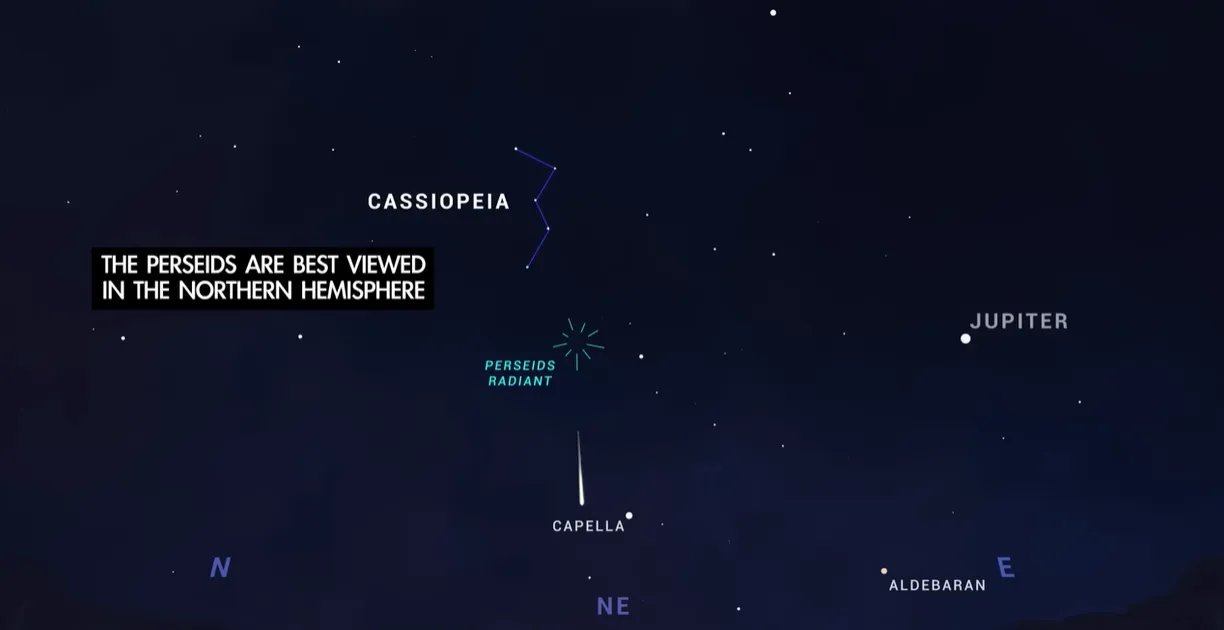
The Perseids appear to come from a point in the constellation Perseus, called the radiant. On August evenings in the UK, Perseus sits low in the north-east and climbs higher as the night goes on, which is why rates improve after midnight.
The easiest way to find it is to start with Cassiopeia, the bright W- or M-shaped group of stars high in the north-east. Perseus lies just below it, a curving line of stars heading down towards the horizon. The radiant sits between the two.
Credit: science.nasa.gov
You don’t need to look straight at the radiant to see meteors. Trace any Perseid backwards and it will point back to this area, which is how you can tell a Perseid from a random meteor. Those that appear further from the radiant often have the longest, most dramatic trails.
Why the Perseids are special
The Perseids are known for fireballs: meteors brighter than the brightest planets, which can light up the sky for a moment and sometimes leave a glowing trail that lingers for a few seconds. They’re also one of the few major showers that peak in summer, when the nights are mild enough to lie outside for hours.
The trade-off is short nights. In the UK, August skies don’t get properly dark until late in the evening, especially in Scotland and the north of England, so the darkest window is shorter than for winter showers like the Geminids.
How to watch the Perseids
You don’t need a telescope or binoculars. In fact, they’d only narrow your view. Meteors can appear anywhere in the sky, so the best way to watch is with your eyes and as much open sky as possible.
- Find a dark spot. Get away from streetlights and town glow. The darker the sky, the more of the fainter meteors you’ll see.
- Lie back. A reclining chair, mat or blanket makes it far more comfortable to look up for an hour or more.
- Don’t stare at Perseus. Look about halfway up the sky, slightly away from the radiant. Meteors further from it tend to have longer, more impressive trails.
- Let your eyes adjust. It takes around 20 minutes for your eyes to adapt to the dark. Avoid looking at your phone, or switch on its red night mode.
- Be patient. Meteors often come in bursts, with quiet spells in between, so give it at least an hour.
Where to watch the Perseids in the UK
The single biggest thing you can do to see more Perseids is to get under a dark sky. Away from towns and streetlights, the fainter meteors that make up most of the shower suddenly appear, and a quiet trickle can become a steady show.
The UK has some of the darkest skies in Europe, protected in a network of International Dark Sky Parks and Reserves across England, Scotland and Wales. Anywhere rated Bortle 3 or darker on the Bortle scale will give you an excellent view. Explore all the UK’s dark sky places to find the one nearest you.
For the best experience, stay somewhere you can step straight outside after midnight without driving anywhere. Browse all our dark-sky stays to find one under a properly dark sky.Photographing the Perseids
If you’d like to capture a meteor, put your camera on a tripod, use a wide-angle lens and take a series of long exposures (around 15–25 seconds each) pointed at a dark area of sky. Most shots will be empty, but over an hour or two you have a good chance of catching a bright one. Many cameras can take shots continuously with an interval timer.
Perseid meteor shower FAQs
When do the Perseids peak?
Every year around 12–13 August, though meteors can be seen from mid-July to late August.
How many meteors will I see?
Up to around 100 an hour at the peak under a perfectly dark sky. From a rural dark sky site, a few dozen an hour is a good night.
What time is best?
After midnight until dawn, when Perseus is highest in the sky.
Do I need a telescope?
No. The Perseids are best seen with the naked eye, so you can take in as much of the sky as possible.
Can I see the Perseids from a city?
You’ll see the brightest ones, but light pollution hides most of the fainter meteors. A dark sky site makes a dramatic difference.