
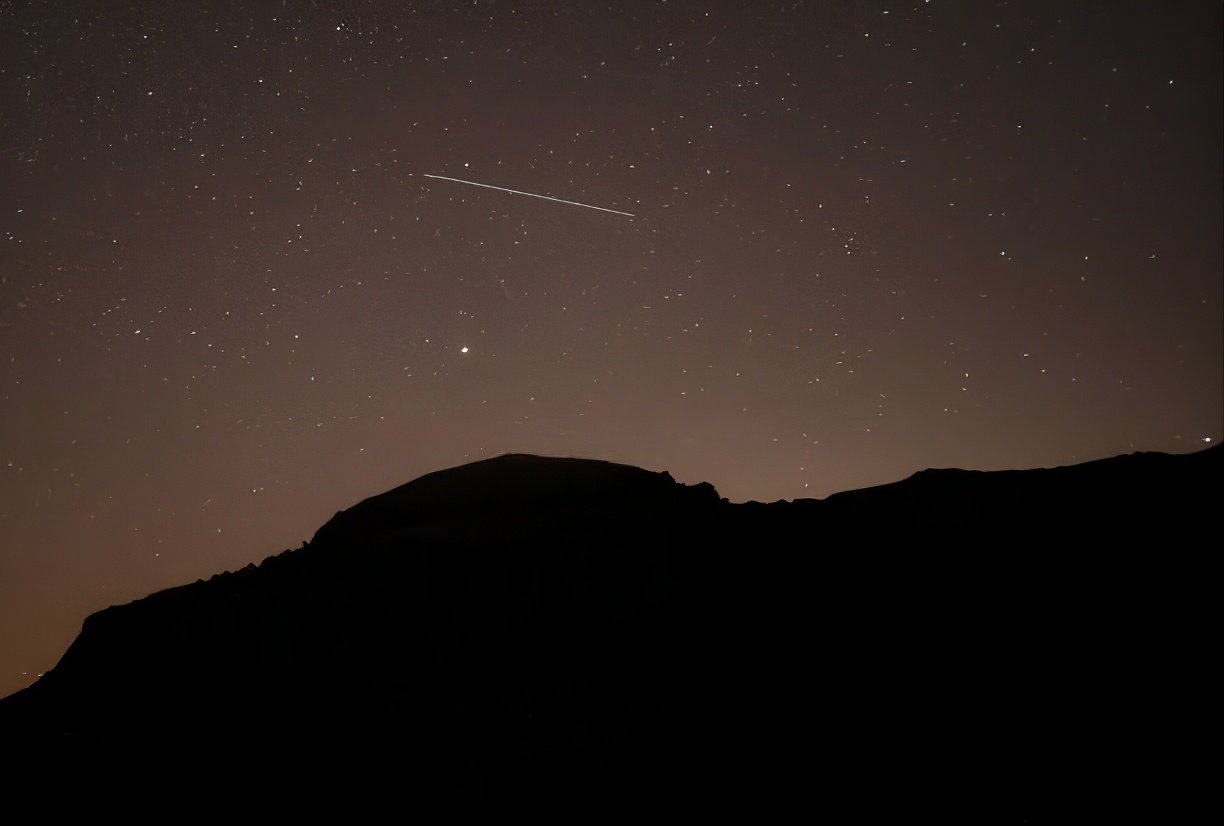
Leonid Meteor Shower
What are the Leonids?
The Leonids are produced by debris from Comet Tempel–Tuttle, which orbits the Sun once every 33 years. Every November, Earth passes through the dust it has left behind, and the particles burn up in our atmosphere as meteors.
The shower gets its name from Leo, the constellation the meteors appear to come from. Their radiant sits in the Sickle, a curve of stars shaped like a backwards question mark that marks the lion’s head and mane.
Why the Leonids are special
The Leonids are the fastest meteors of any major shower. They hit Earth’s atmosphere head-on at around 44 miles per second, so they often look sharp and bright, and some leave glowing trails, called persistent trains, that can hang in the sky for several seconds.
They’re also famous for meteor storms. In most years the Leonids are a modest shower, with around 10–15 meteors an hour. But when Earth passes through a dense, fresh trail of debris, usually in the years around the comet’s return, rates can climb dramatically. In 1833, observers in North America reported meteors falling “like snow”, and the 1966 storm produced thousands of meteors a minute for a short time. Strong displays were seen again around 1999–2002.
Tempel–Tuttle next returns to the inner solar system in 2031, so the early 2030s may bring stronger Leonid displays again, though a storm is never guaranteed.
When to see the Leonids
The Leonids are active from around 6 to 30 November, peaking on the night of 17–18 November. The peak is fairly short, so the night of the 17th is the one to aim for, with the nights either side worth trying too.
Unlike the Geminids, the Leonids are a late-night shower. Leo doesn’t rise until around midnight in November, so the best time to watch is from about 3am until dawn, when the radiant is high in the south-east.
The Moon makes a big difference each year. A bright Moon will hide the fainter meteors, so check its phase before you plan your night.
How to find the radiant
In the early hours of a November morning, look east-south-east for the Sickle of Leo, a backwards question mark of stars with the bright star Regulus at its base. The Leonid radiant sits within the Sickle.
You don’t need to look straight at the radiant. Leonids can appear anywhere in the sky, and if you trace one back, it will point towards Leo. Their speed is a giveaway too: a Leonid flashes across the sky noticeably faster than most other meteors.
What you’ll actually see
How many Leonids you see depends on how dark your sky is. These are typical counts per hour around the peak, in a normal year, on a clear night with no Moon:
- Town or city (Bortle 6–9): 1–3
- Village or rural edge (Bortle 4–5): 5–8
- Dark sky park or reserve (Bortle 1–3): 10–15
Every stay on Starnook is rated on the Bortle scale, so you know how dark the sky will be before you go.
How to watch the Leonids
- Set an alarm. The best viewing is before dawn, so get some sleep in the evening and head out from around 3am.
- Find a dark spot. The darker your sky, the more of the fainter meteors you’ll catch.
- Wrap up warm. Pre-dawn temperatures in late November can be well below freezing. Wear layers, a hat and gloves.
- Lie back. A reclining chair or mat makes it far easier to watch for an hour.
- Look for trains. After a bright Leonid, keep looking at the spot where it vanished. You may see a faint glowing trail drift and fade.
Where to watch the Leonids in the UK
The darker your sky, the better your chance of seeing the Leonids, especially in a normal year when rates are modest. The UK has some of the darkest skies in Europe, protected in a network of International Dark Sky Parks and Reserves across England, Scotland and Wales. Explore all the UK’s dark sky places to find the one nearest you.
For a pre-dawn shower, it helps to stay somewhere you can step straight outside at 3am without driving. Browse all our dark-sky stays to find one under a properly dark sky.
Leonid meteor shower FAQs
When do the Leonids peak?
Every year around the night of 17–18 November, with the shower active from about 6 to 30 November.
How many meteors will I see?
In a normal year, around 10–15 an hour under a dark sky. In rare storm years, rates can be far higher.
What time is best?
From around 3am until dawn, when Leo is highest.
What is a meteor storm?
A burst of more than 1,000 meteors an hour. The Leonids are the best-known shower for storms, which happen when Earth passes through a dense, fresh trail of debris from Comet Tempel–Tuttle.
Do I need a telescope?
No. Meteors are best seen with the naked eye, so you can take in as much of the sky as possible.