
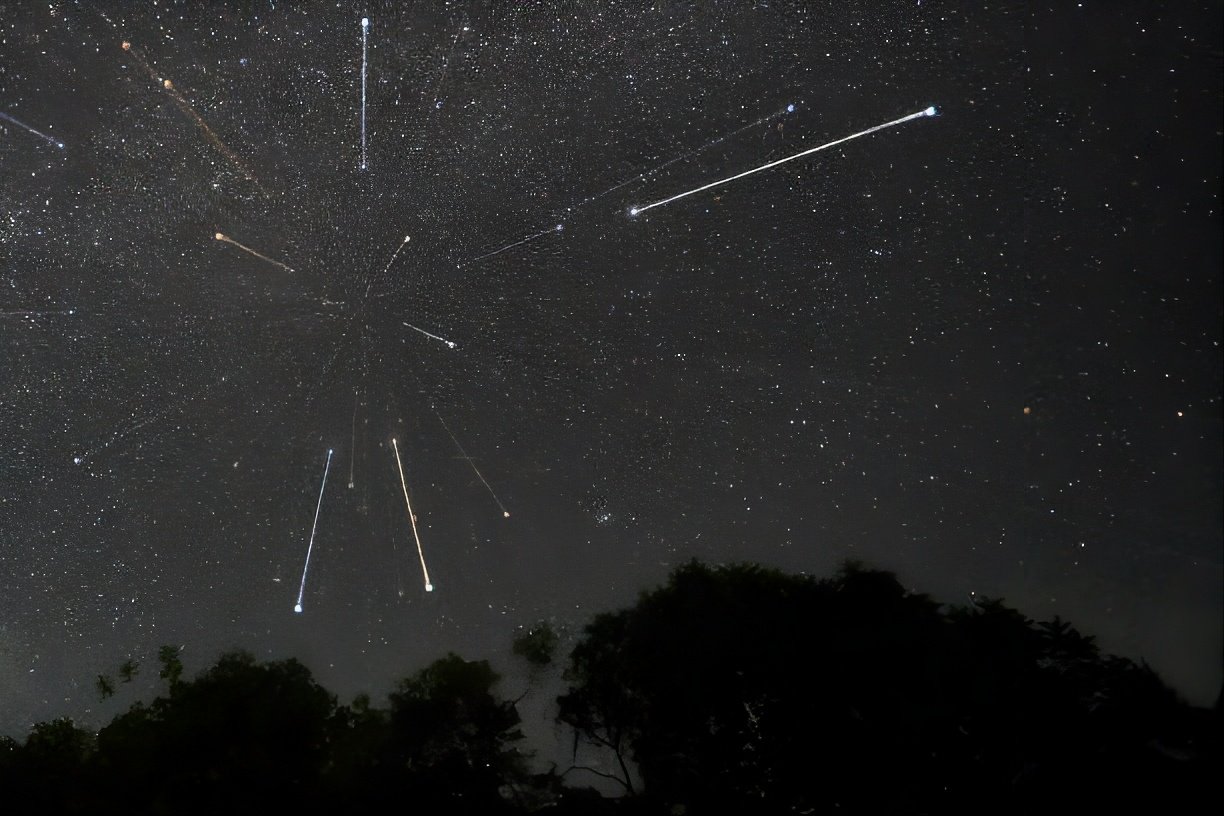
Geminid Meteor Shower
What are the Geminids?
The Geminids are the strongest meteor shower of the year. Every December, Earth passes through a stream of debris, and the particles burn up in our atmosphere as bright streaks of light, sometimes more than a hundred an hour under a dark sky.
What makes the Geminids unusual is where they come from. Almost every meteor shower is caused by a comet, but the Geminids come from 3200 Phaethon, a small asteroid around 3 miles across. Phaethon passes so close to the Sun that its surface is baked and cracked, shedding rocky debris along its orbit. Astronomers sometimes call it a “rock comet”.
The shower gets its name from Gemini, the constellation the meteors appear to come from.
Why the Geminids are special
The Geminids are bright, plentiful and easy to see. Their meteors enter the atmosphere at around 22 miles per second, slower than many showers, so they often last long enough to follow across the sky. Many are bright, and some show colours, including yellow, green and blue.
They’re also unusually convenient. Most major showers are best in the early hours, but the Geminids’ radiant rises in the early evening, so you can start watching after dinner rather than setting a 3am alarm.
When to see the Geminids
The Geminids are active from around 4 to 20 December, peaking on the night of 13–14 December. Rates build for several nights before the peak and fall away quickly afterwards, so the nights of the 12th and 13th are the best back-ups if the peak is cloudy.
You can start watching from about 10pm, when Gemini is well up in the east. Rates usually reach their best around 2am, when the radiant is highest in the sky, but meteors keep falling right through to dawn.
The Moon matters each year. A bright Moon will hide the fainter meteors, so check its phase before you plan your night.
How to find the radiant
The Geminids appear to come from near Castor, one of the two bright stars that mark the heads of the twins in Gemini. The other, Pollux, sits close beside it. On December evenings, look east and you’ll find them to the left of Orion, rising higher through the night.
You don’t need to look straight at the radiant. Meteors can appear anywhere in the sky, and those further from it often have the longest trails. If you trace a meteor back and it points towards Castor and Pollux, it’s a Geminid.
What you’ll actually see
How many Geminids you see depends on how dark your sky is. These are typical counts per hour around the peak, on a clear night with no Moon:
- Town or city (Bortle 6–9): 10–20
- Village or rural edge (Bortle 4–5): 30–50
- Dark sky park or reserve (Bortle 1–3): 60–100 or more
Every stay on Starnook is rated on the Bortle scale, so you know how dark the sky will be before you go.
How to watch the Geminids
- Find a dark spot. Away from towns and streetlights, the fainter meteors appear and the show becomes far richer.
- Dress for winter. December nights can drop well below freezing. Wear layers, a hat and gloves, and bring a blanket or sleeping bag.
- Lie back. A reclining chair or mat lets you watch for an hour or more without straining your neck.
- Let your eyes adjust. Allow around 20 minutes, and keep your phone off or on red night mode.
- Bring a warm drink. A flask of something hot makes a long December session far more enjoyable.
Where to watch the Geminids in the UK
The single biggest thing you can do to see more Geminids is to get under a dark sky. The UK has some of the darkest skies in Europe, protected in a network of International Dark Sky Parks and Reserves across England, Scotland and Wales. Explore all the UK’s dark sky places to find the one nearest you.
For somewhere to stay, see our guide to the best places to stay for the Geminids in the UK, or browse all our dark-sky stays.